

Trust Bank Interest Rates Update: Is It Still Worth Using?
Trust Bank recently revised its interest rates in Singapore. This 2026 review explains what changed, how the savings plans compare, and whether Trust Bank is still worth using.
If you’ve been following the channel for a while, you’ll know that I’ve generally been a fan of Trust Bank. They’ve introduced features that people actually want to use — or at least features that have worked well for me personally.
But with their latest interest rate revision, I found myself re-evaluating whether Trust still makes sense as a place to park my savings, or whether there are better ways to maximise my money elsewhere.
A few days ago, I received an email from Trust Bank announcing another round of changes to their savings account interest rates — and this time, the changes are worth paying attention to.
A Quick Recap: What Changed?
The previous revision in December 2024 already reduced Trust’s interest rates to:
0.75% base interest
An additional 0.75% bonus for NTUC union members
Or 0.4% bonus for non-members
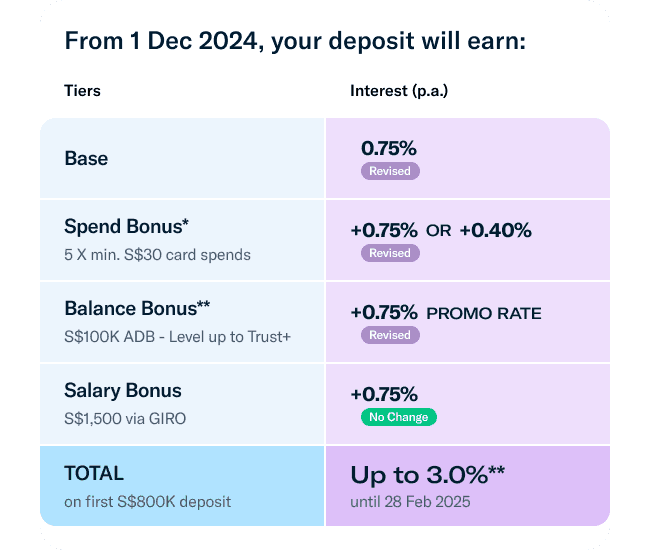
Trust Bank Interest Changes in 2024
While higher interest tiers were technically possible, the requirements were honestly quite difficult to hit for most people.
The Latest Revision (Effective 1 March 2026)
Now, Trust is cutting rates further:
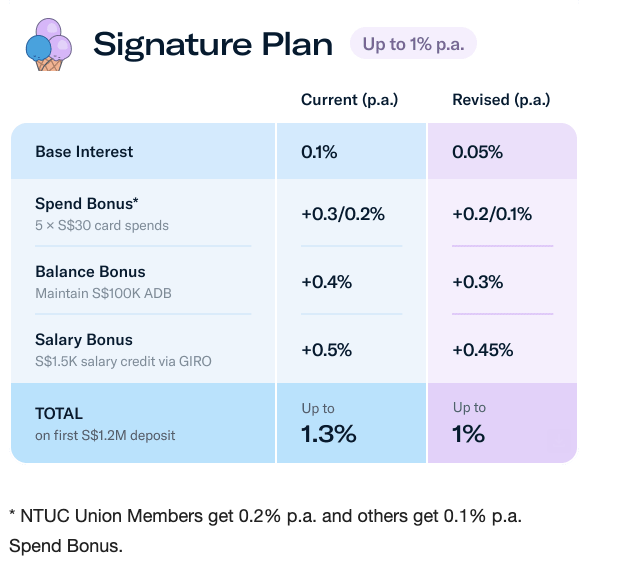
Base interest drops from 0.1% to 0.05%
NTUC members: an additional 0.2% on spend
Non-members: an additional 0.1% on spend
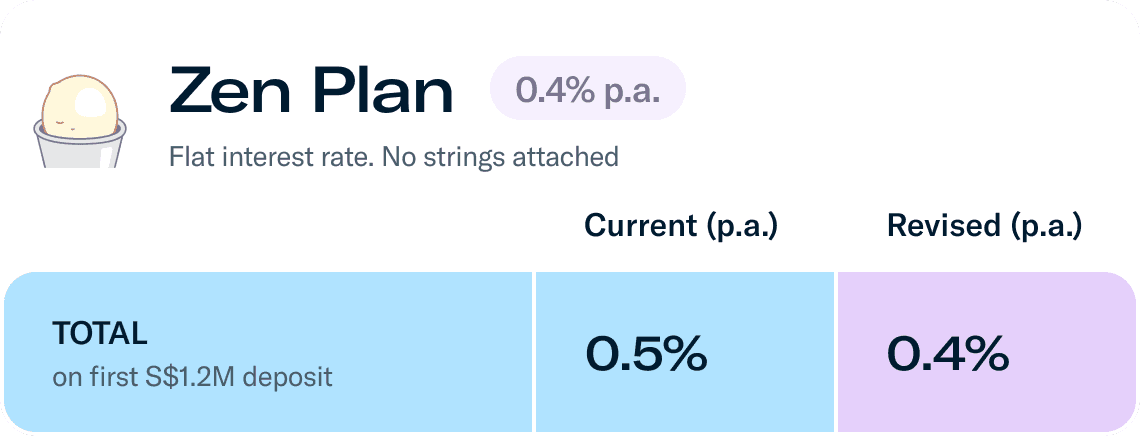
With interest rates going in the wrong direction, it naturally raises a concern:
“Is your money still working hard enough for you?”
Work is already hard. The cost of living isn’t getting cheaper. Most of us are trying to retire earlier, not later — so every percentage point matters.
The 3 Trust Bank Savings Plans Explained
Trust Bank currently offers three different savings plans:
Signature Plan
Flex Plan
Zen Plan
Ironically, more choices don’t always help. For many people, it leads to confusion or decision paralysis. So let’s break down who each plan is really for.
1. Signature Plan — Familiar, But Less Competitive
The Signature Plan is closest to Trust’s old structure.
Trust Bank Signature Plan
To earn a higher bonus interest, you’ll need:
At least 5 Card Spends of S$30
Average Daily Balance(ABD) of S$100,000 or more
S$1,500 of Monthly Salary Crediting
This structure should look very familiar — it’s almost identical to traditional high-interest savings accounts, such as UOB ONE, which also require salary crediting, card spend, and minimum balances.
Quick Comparison: Trust vs UOB ONE
Assuming:
Both users credit salary
Both spend S$500/month
Balance of S$10,000
UOB ONE
Earns roughly S$100/year
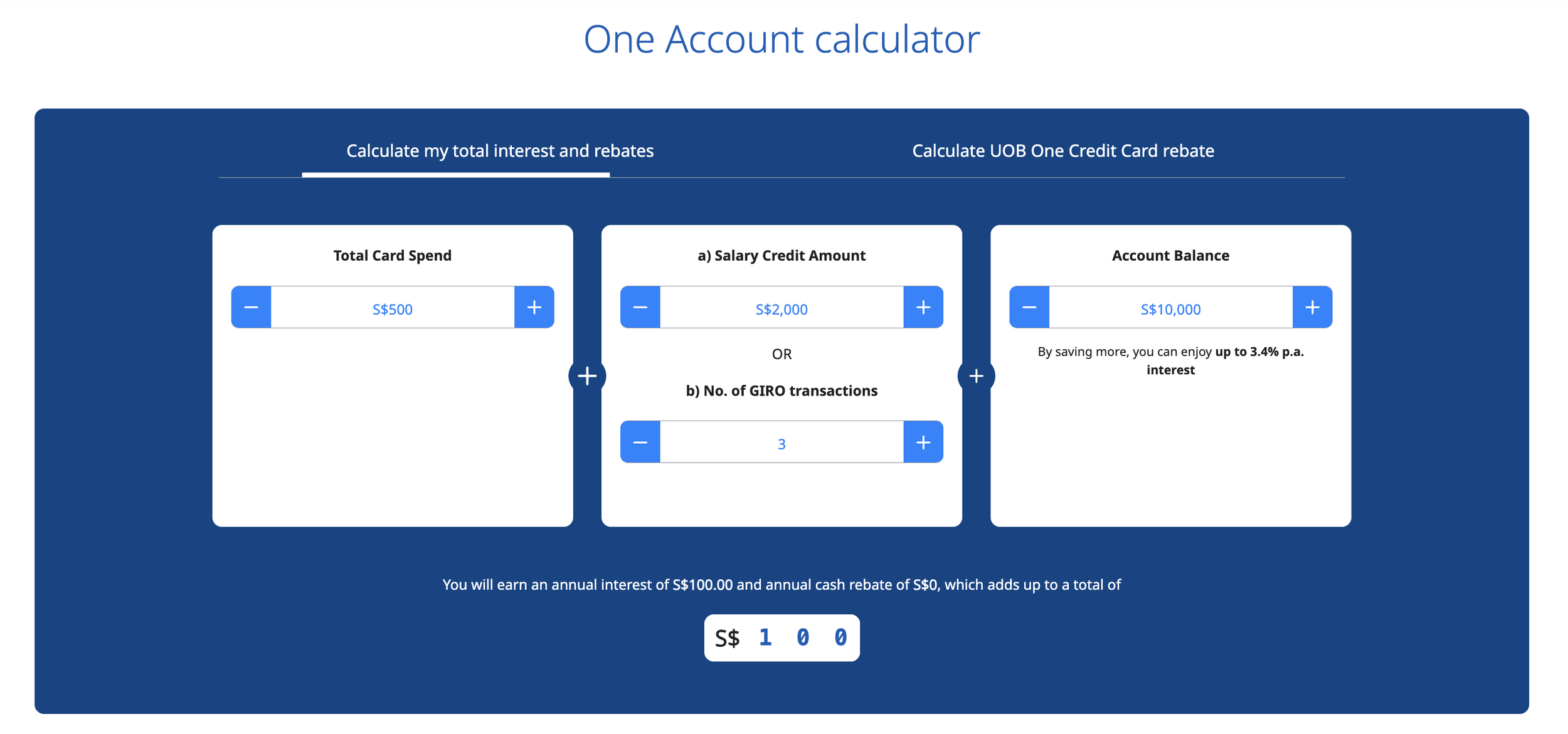
UOB ONE Account Annual Interest
Trust Signature
Earns about S$6.67/month (Non-NTUC Union Member) or $7.50/month (NTUC Union Member)
Annual Total: ~S$80 - $90/year
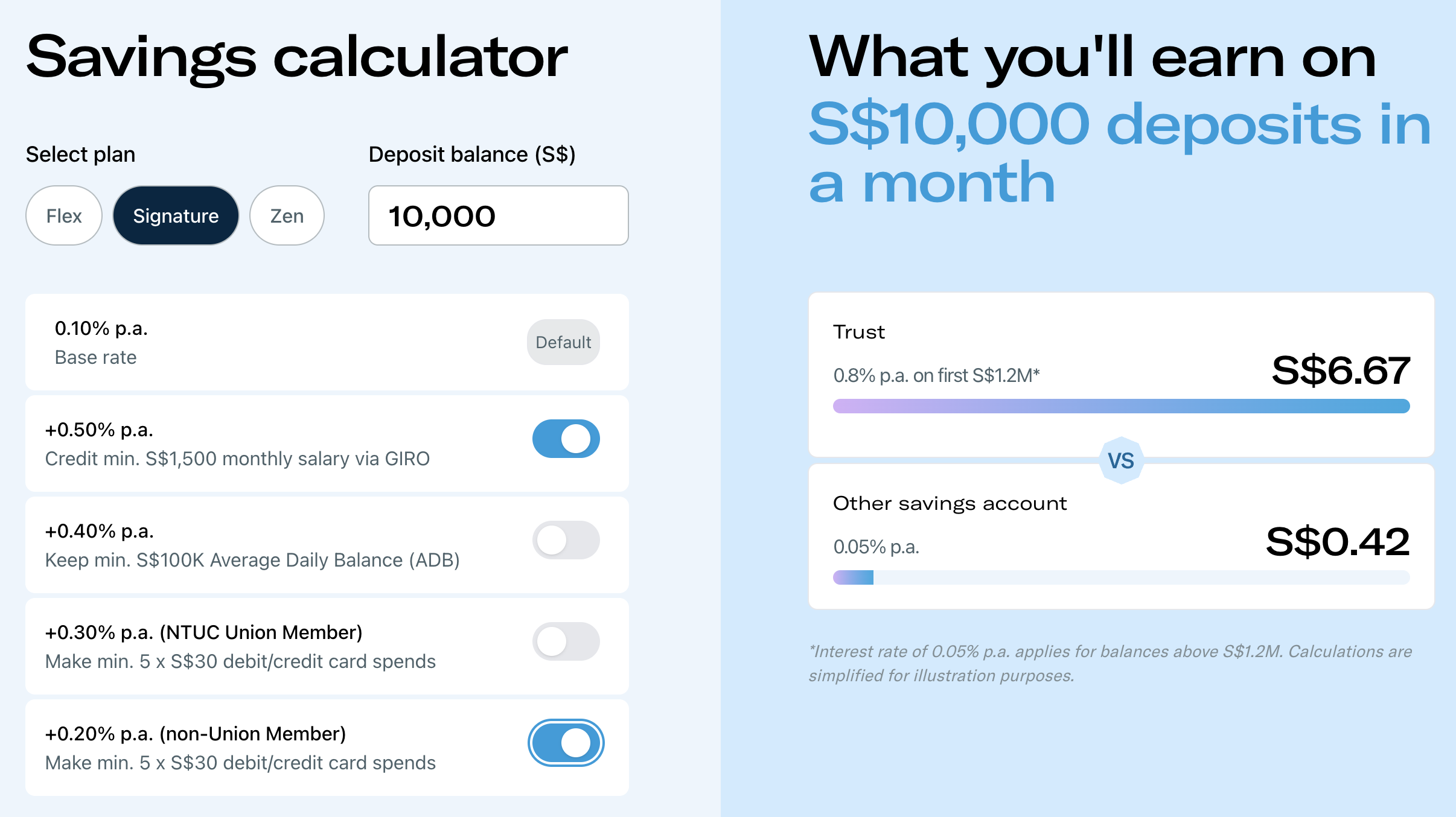
Interest rate for Non-NTUC Union Member on Trust Signature Plan
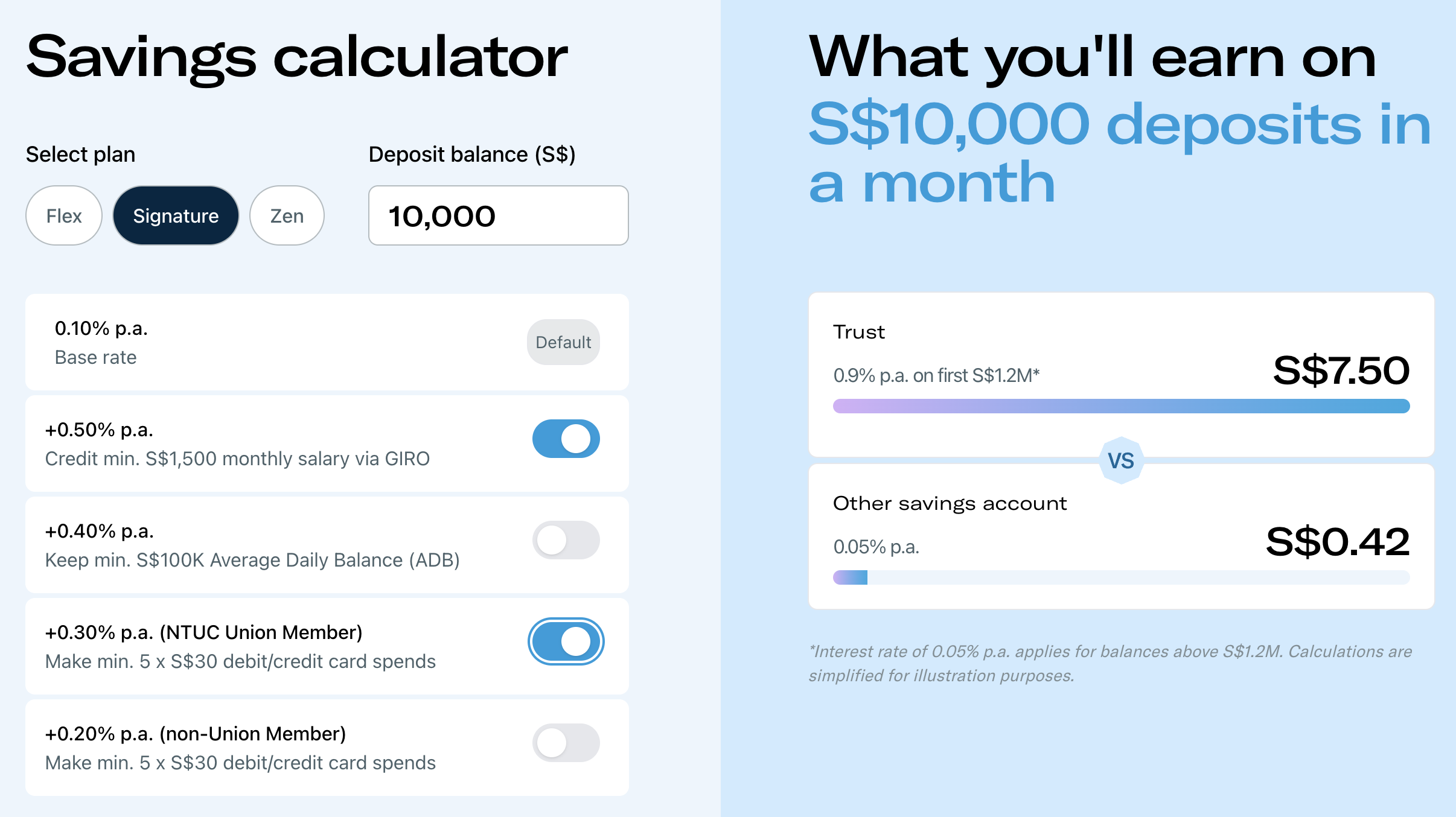
Interest rate for NTUC Union Member on Trust Signature Plan
It’s not terrible, but it’s clearly less competitive. I’ll leave calculator links on the site so you can plug in your own numbers and see what makes sense for you.
2. Flex Plan — Gamified, But Tricky
The Flex Plan is where things get interesting — and slightly complicated.
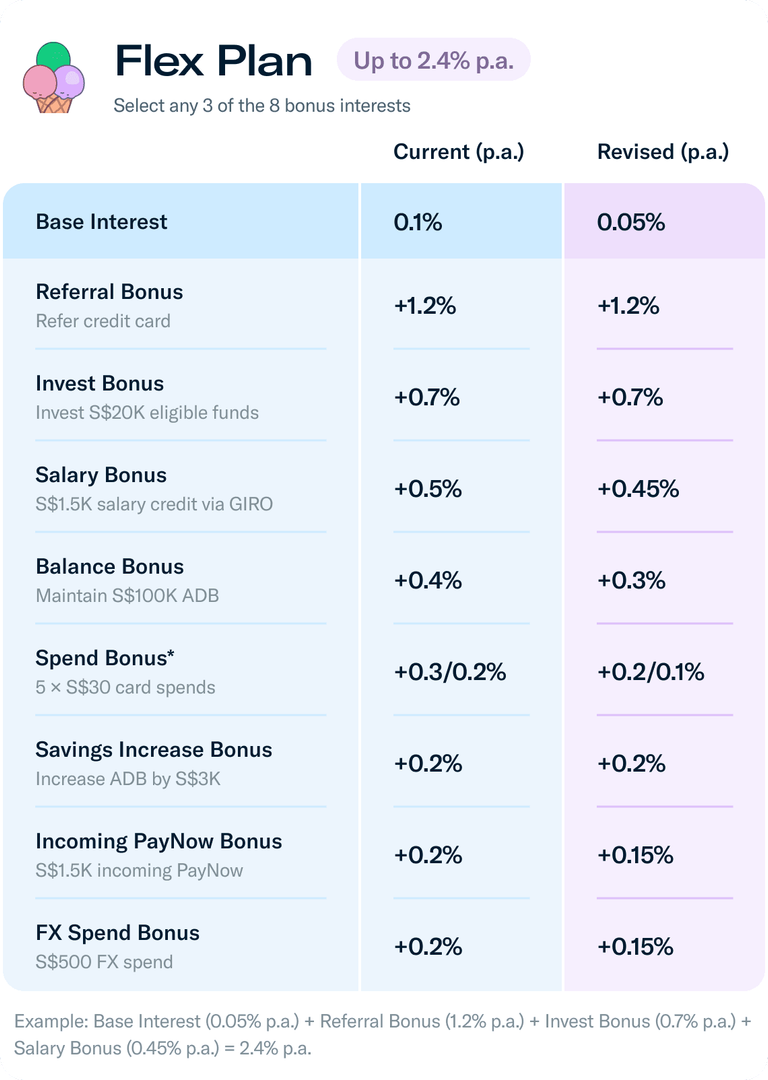
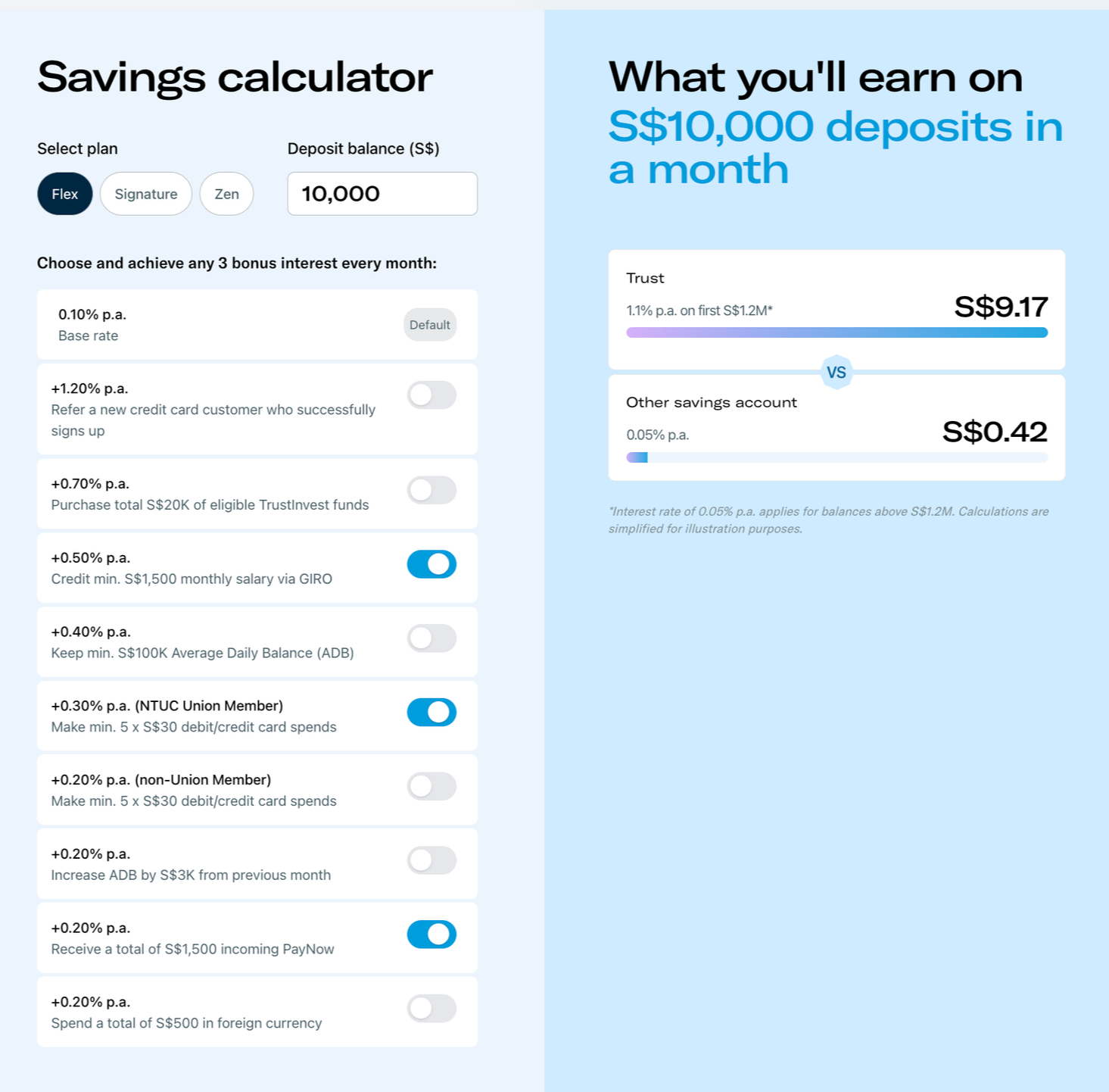
This plan “gamifies” savings by letting you choose 3 missions (Trust calls them categories) to earn bonus interest. Each mission comes with a different interest boost.
Trust Bank Flex Plan Interest Rates
Flex Plan Missions:
Base rate: 0.1%
Refer a friend: +1.2%
Invest S$20,000 in TrustInvest: +0.7%
Salary credit S$1,500: +0.5%
ADB ≥ S$100,000: +0.4%
5 × S$30 card spends:
+0.3% (NTUC members)
+0.2% (non-members)
Increase ADB by S$3,000: +0.2%
Receive S$1,500 via PayNow: +0.2%
Spend S$500 in foreign currency: +0.2%
As you can see, lots of options, which also means a lot of mental overhead.
The “Best” Trust Bank Flex Plan Setup That Actually Works
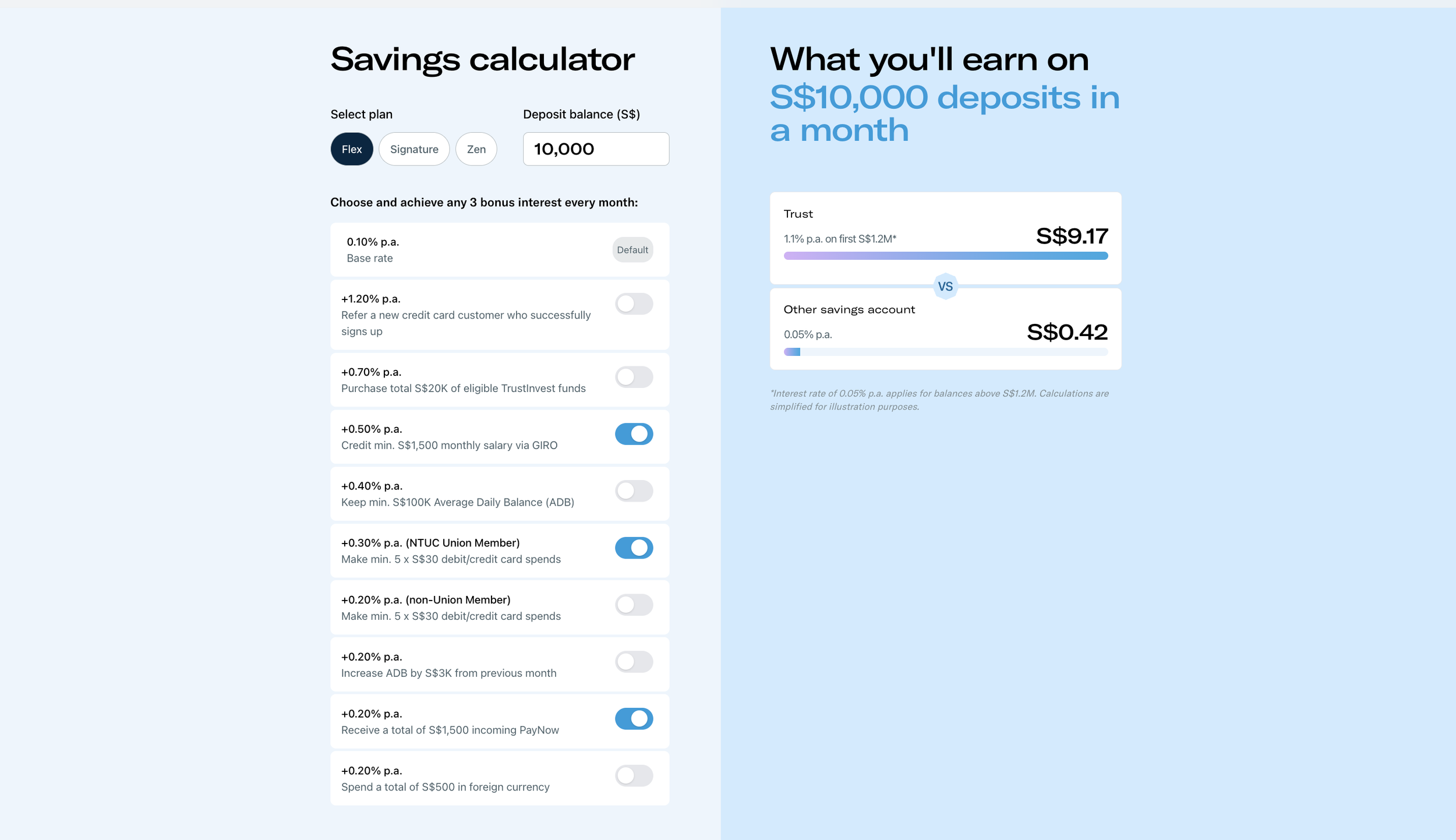
In my opinion, the Flex Plan only makes sense if you keep it simple:
S$1,500 salary credit
Debit/credit card spend
PayNow inflow
That gives you:
0.1% base
+0.5% salary credit
+0.3% card spend (or 0.2% non-member)
+0.2% PayNow
On a S$10,000 balance, this gets you almost the same interest as UOB ONE, with one big difference:
Best way to maximize your money with Trust Bank Flex Plan
👉 Trust only requires ~S$150 spend,
👉 while UOB ONE requires S$500.
The difference in interest is about S$1 max — which honestly isn’t bad.
3. Zen Plan — Simple and No Stress
The Zen Plan lives up to its name.
Flat 0.5% interest
No salary credit
No spending requirements
No conditions
It’s not exciting, but it’s predictable — and for some people, that’s exactly what they want.
So… Should You Stay With Trust?
These changes force us to think more carefully about how we structure our finances.
Personally, savings interest is not the main reason I use Trust.
I don’t keep much SGD lying around. As I’ve shared in previous videos, I’m using stablecoins to earn higher yields, and that strategy has been working well for me.
What I Actually Use Trust For:
Overseas Spending
Category Spending with up to 15% cashback
And here’s the silver lining 👇
Cashback Card Upgrade (Good News!)
From 1 March 2026, while savings rates drop, the Trust Cashback Card actually improves.
Previously:
You didn’t earn the 1% base cashback on selected categories if you already got the 15% bonus
After 1 March 2026:
You’ll get both:
1% base cashback
+ category bonus
On top of that:
0% FX fees
Excellent exchange rates that beat most neo-banks and broker cards
This has become my go-to card for work travel, and I don’t see that changing anytime soon.
Final Take
For my personal use case:
Trust Cashback Card → still very worth it
Salary credit & savings → UOB ONE works better for me
If you’re considering Trust — or haven’t tried it yet — use promo code: 2KAMXV1S to get up to $1,888 worth of cashback!
Share this with a friend who’s deciding whether to use Trust.
As always — stay safe, invest safe, and I’ll see you in the next one.
