

I Tried Four Cards in Korea. Here's What the Receipts Actually Tell Us.
When I travelled to Korea, I used 4 different cards for five purchases because I wanted to test an everyday money question: does zero foreign-exchange fee matter more than a bigger cashback percentage?
I expected a straightforward answer, but I didn't get one. And that's partly because the experiment wasn't controlled: my purchases happened at different times and amounts, one card was billed in US dollars, and not every reward was confirmed. So it would be misleading to award a winner.
But those receipts are still useful. They show 3 things worth checking whenever you spend overseas:
1) The final amount charged
2) The reference exchange rate
3) The reward you can actually use.
The three-step card test
1. What did I pay?
Start with the completed card statement. Record the local currency, actual billed amount and currency, and any separately disclosed fee. Do not count an authorisation as a final charge unless it has settled. Hot tip: You can take a screenshot of the transaction, and AI can do most of the calculation for you.
2. What was the reference price?
Find a published market exchange-rate observation around the date of spending. For example, if a merchant charged in Korean won and the card billed Singapore dollars, convert the won amount using a clearly dated KRW/SGD reference. This is a guide, not a guaranteed rate available to a retail cardholder. Published daily figures may not match the card-network or settlement-time rate.
3. What reward did I really get?
Check whether it is settled cash, pending cashback, points or crypto. Consider exclusions, caps, minimum claim thresholds and whether its value may change.
What my five transactions show
Trust
₩33,700 became S$32.41. Using a published 16 October SGD/KRW daily reference of 1,043.2552 won per Singapore dollar, the guide amount is about S$32.30. The difference is roughly S$0.11 before the displayed S$0.16 cashback. That difference does NOT mean Trust is charging you an extra $0.11 on the transactions, but it just shows that depending on the card network that’s used as well as the time of purchase, can affect this rate.
YouBiz
A ₩6,000 payment was charged S$5.79. The published 15 October daily reference of 1,045.9449 won per S$1, which means the day rate is roughly S$5.74. There is also an estimated S$0.06 cashback, which usually settles at the end of the month. Something to note is that YouBiz is a corporate business card, unlike the YouTrip card, which is a personal card. This means you’ll need a UEN or ACRA to register for the YouBiz Card.
I also tested another transaction of ₩15,000; I was billed S$14.42, with an estimated S$0.14 cashback.
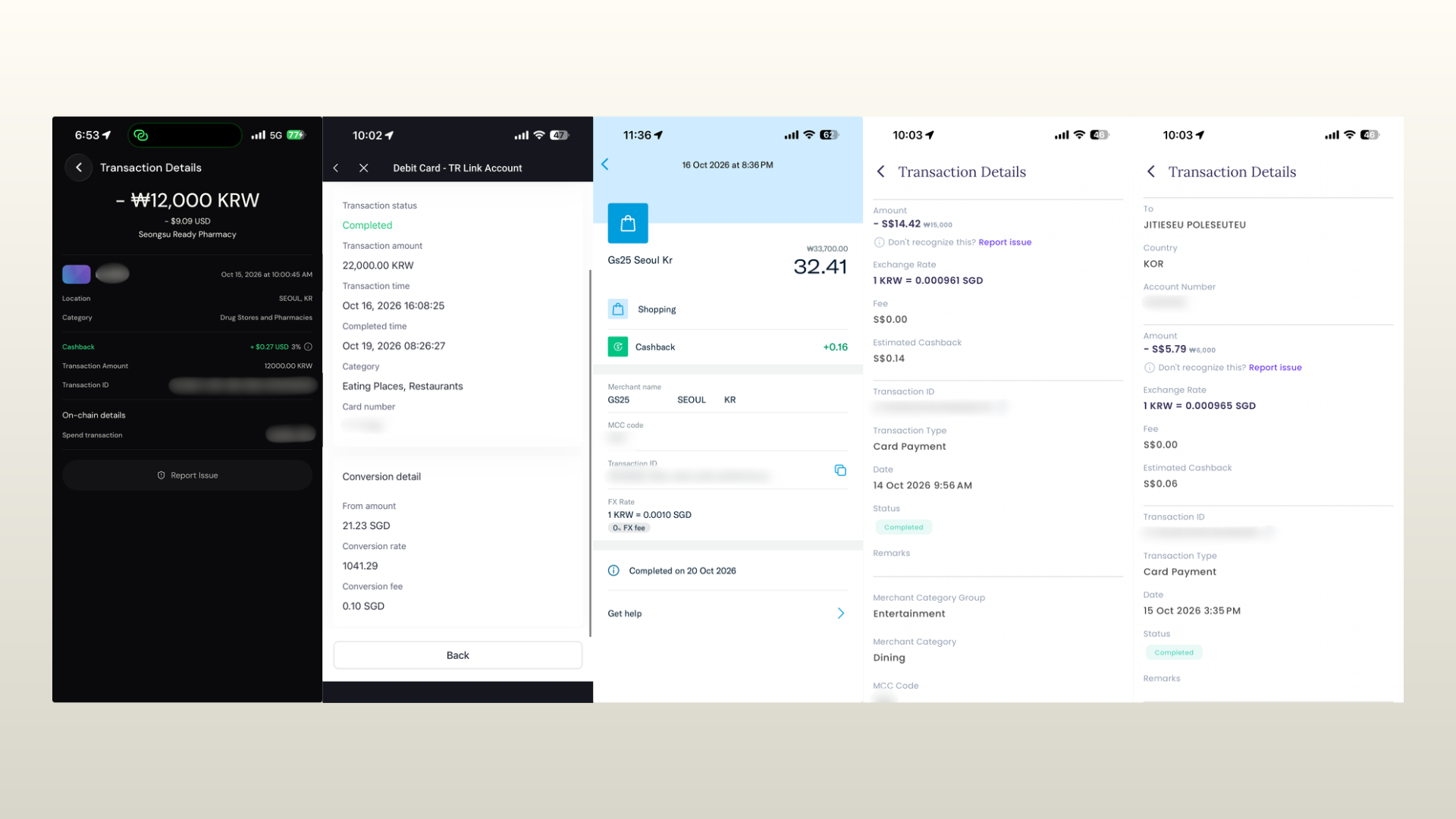
All my transactions I have done in Korea for this test!
TigerBoss
We spent ₩22,000, which showed as S$21.23, with a separate line for a S$0.10 conversion fee. The displayed rate of 1,041.29 KRW/SGD which comes out to ~S$21.13 before that fee, and adding the S$0.10 conversion fee, this brings out total charged to S$21.23. On smaller purchases like mine, the S$0.10 fee can be rather tiny, but if you’re making multiple smaller purchases, the S$0.10 can add up to a huge chunk. Would highly suggest using this only if you want to get stock back as a reward.
ether.fi
Ether.fi is an interesting one and would probably be more suitable for those that have stablecoins or are using crypto for their purchases. I charged ₩12,000, which showed up as US$9.09 and approximately US$0.27 in displayed reward value. The reward involves ETHFI tokens, whose value and accessibility may differ from cash. Once the transaction is settled, you can claim the cashback 7 days after the settlement.
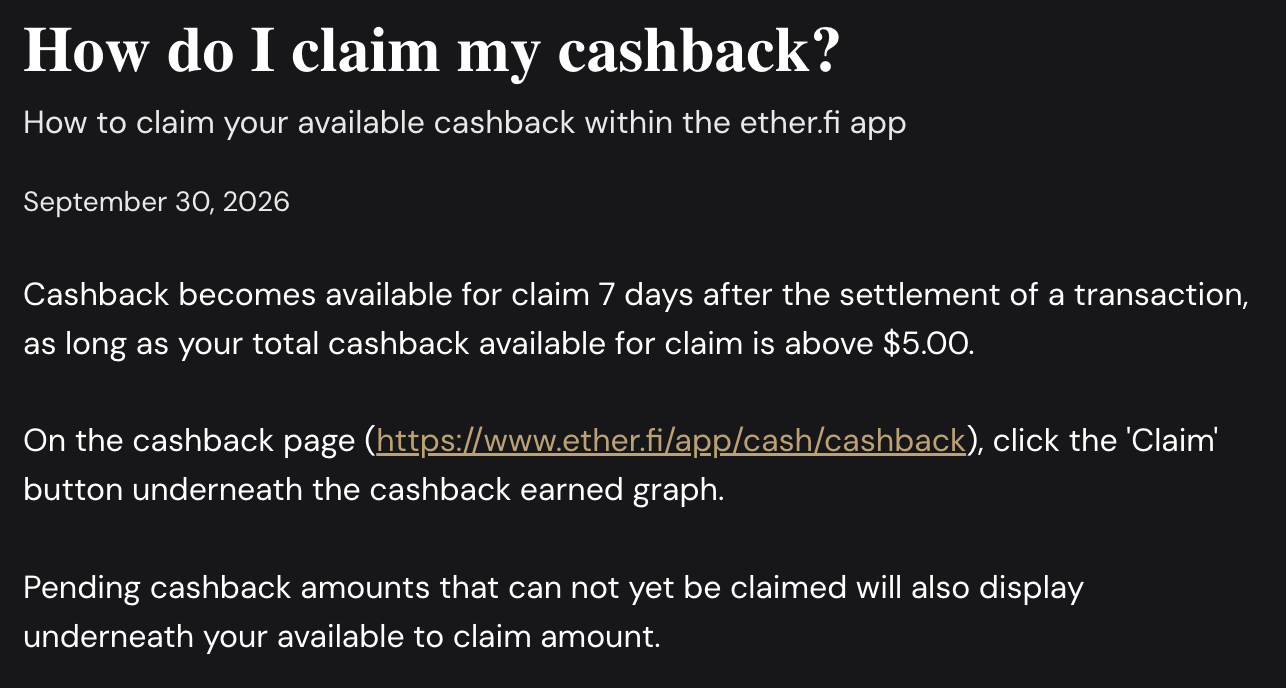
Claiming your etherfi cashback
Why “zero FX fee” can be true without guaranteeing the lowest cost
A provider can waive an explicitly labelled foreign-transaction fee while still using a network or conversion rate that differs from a published market benchmark. That alone is not evidence of deceptive pricing. Rate source, card-network processing, settlement date and currency conversion path all matter.
Why “3% cashback” can be worth less than it sounds
Rewards can be conditional, capped, paid later, paid in points or crypto, or excluded for certain transactions. Always ask what the reward is worth when it becomes usable. Cashback quoted in a different currency isn't an automatic reduction in your Singapore-dollar bill.
My conclusion
I won't call one card the winner from this trip. For your next overseas purchase, use the three-step check: what did I pay, what was the market-rate guide, and what could I actually redeem? It takes a little longer than comparing advertising slogans, but it leaves you with a decision you can explain.
