

I tested 3 Crypto Cards in Vietnam, so you don't have to
Just got back from Vietnam. And I brought 3 crypto debit cards — Ready, EtherFi, and KAST — and used all 3 on actual purchases across the trip.
This is not a spec comparison. It’s real merchants, real Vietnamese Dong, real USDC leaving my wallet. And after every transaction, I pulled the mid-market rate for that date and worked out what each card actually cost me.
If you're in Singapore, holding USDC on-chain, and wondering which crypto card to bring on your next trip, this is the data I wish I had before I left.
The FX spread is the cost nobody talks about.
Most people picking a crypto travel card are looking at the wrong thing. They compare cashback percentages or sign-up bonuses and ignore the FX spread entirely.
The FX spread is the gap between the exchange rate your card gives you and the actual mid-market rate — the rate you'd see on Wise.com or XE.com with no markup. Banks make money here. Card providers make money here. And if you're not checking it, you're paying it without knowing.
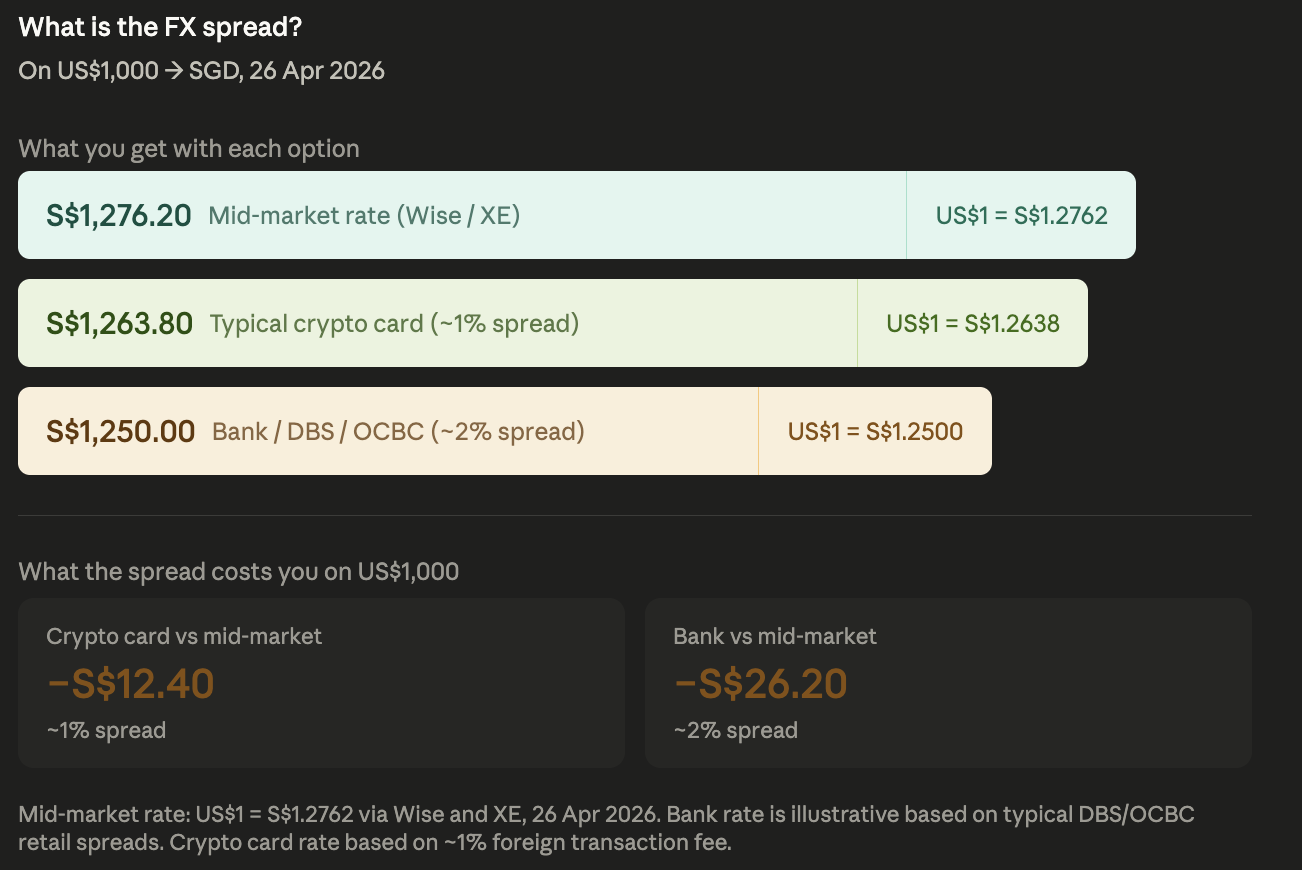
Difference between Mid-Market, 1% spread and Bank’s FX Spread. Illustrations purposes only.
Here's the thing: a 1% FX spread doesn't sound like much. But on a two-week trip, spending $3,000, that's $30 silently leaving your pocket, even before you count your rewards. If your cashback or points rewards don’t cover that gap, you are technically still on a loss.
So for this trip, I tracked 3 things per card: the FX spread, any transaction fees, and what I earned back in rewards. That's the full picture.
Getting set up: Easier than you'd think
Before we get into the data, it's worth addressing the obvious question: Is it actually practical to get these cards before a trip?
For all three, the answer is yes — and faster than most people expect.
The application process for each card is straightforward. Standard KYC: Name, ID, Selfie. No branch visit, no waiting for a physical card before you can start spending. All three issue a digital card immediately after approval, which you can add to Apple Pay and start using within minutes. That's a meaningful advantage over traditional cards, where you're waiting a week for plastic or metal (if you want more rewards) to arrive.
Funding is the other question. All three cards accept USDC deposits directly from your wallet. If you're already crypto-native, meaning you hold USDC on-chain and know how to send a transaction, the deposit hits almost instantly. There's no bank transfer lag, no waiting for funds to clear. You top up, you spend.
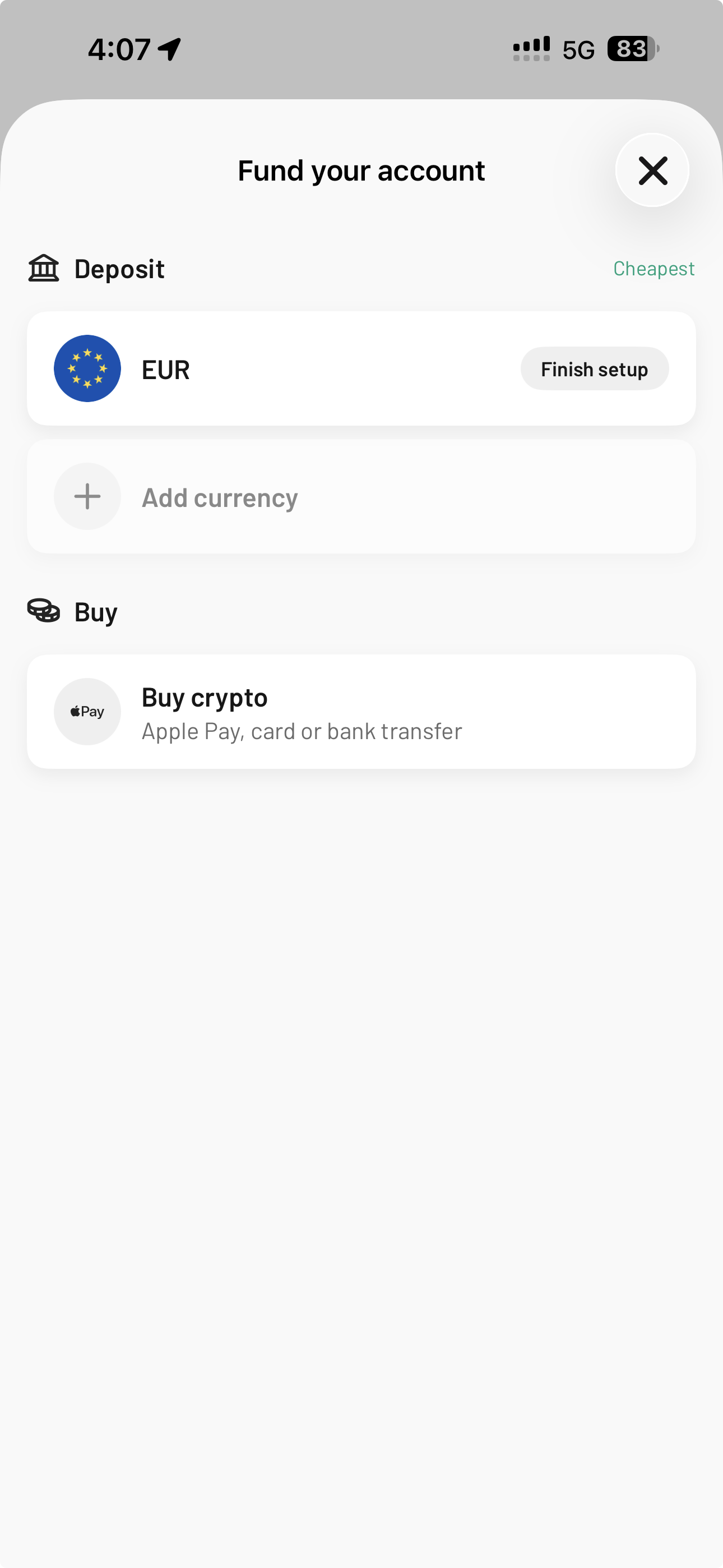
Most wallets allows you to buy Stablecoins with ApplePay, but I feel it’s not worth it.
The one nuance: if you're coming from traditional finance and need to on-ramp SGD or Fiat into USDC first, that step adds friction. But if you're already holding stablecoins, the experience is genuinely seamless. Faster than most neobank top-ups I've done.
What I actually paid on each card in Vietnam
I ran the same transaction through Ready and EtherFi at a coffee shop in HCMC airport, while waiting for a friend. Same ₫59,000. Different cards.
The mid-market rate that day was approximately ₫26,330 per USD, according to the State Bank of Vietnam and Vietcombank published rates.
Ready charged me 2.24 USDC, and working backwards, that's an effective rate of ₫26,339 — basically spot on mid-market. No foreign transaction fee, no spread worth mentioning. That's a clean result.
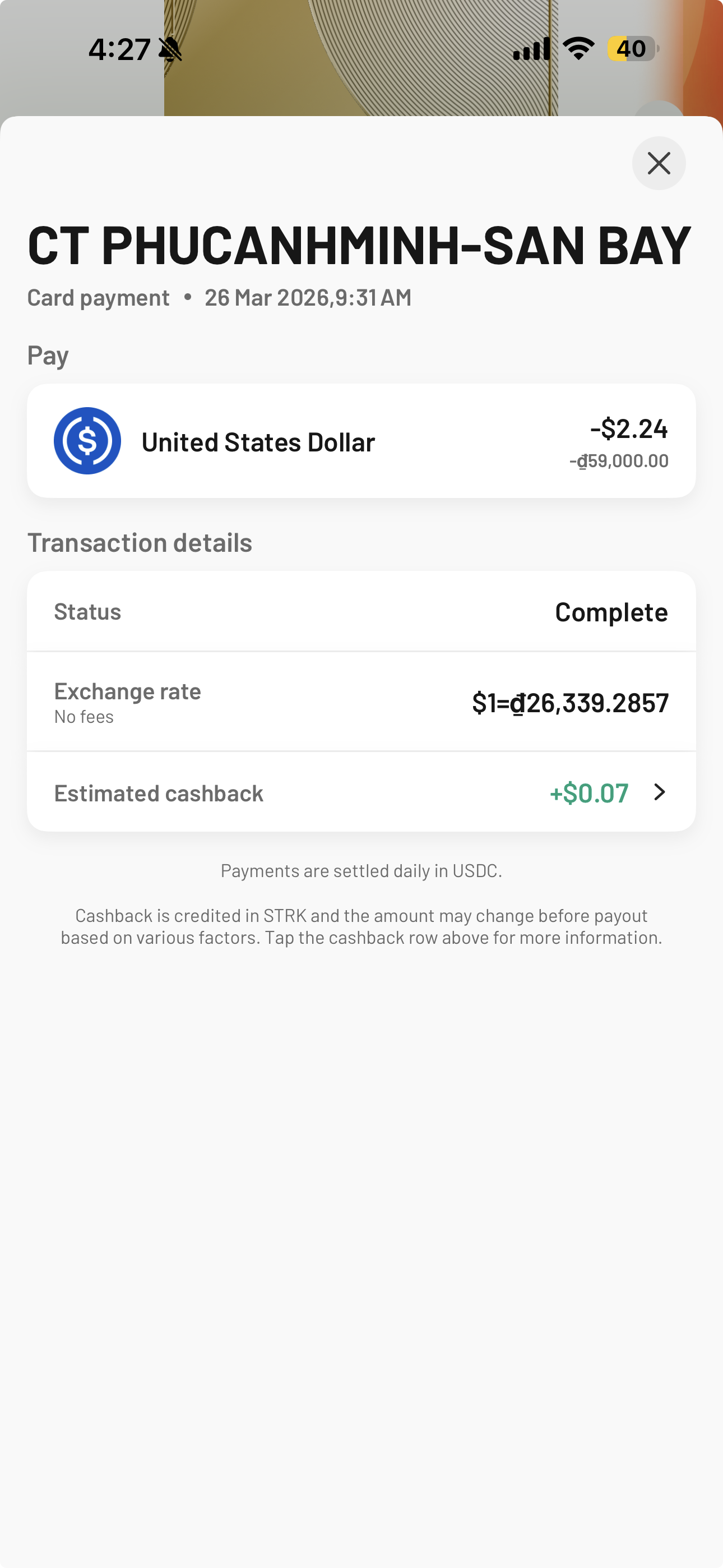
Payment with Ready Card
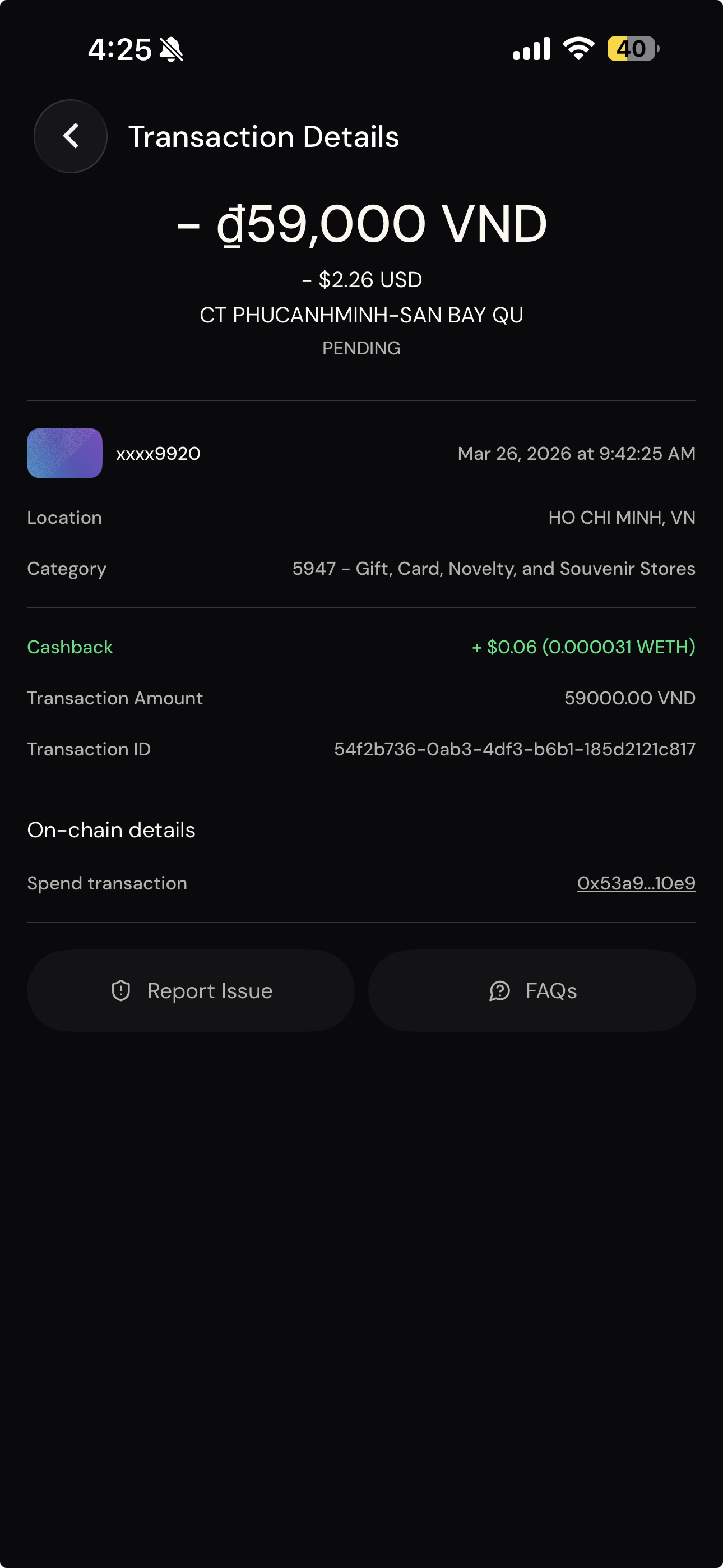
Payment with Etherfi
EtherFi charged $2.25 for the same ₫59,000. Effective rate: ₫26,222. About 0.4% below mid-market. On a $2 coffee, the difference is noise. On a $1,000 trip, it's $4; on $5,000, it's $20. Small but real.
KAST I tested separately, my friend and I went to a bar in Dalat. Bought some drinks which came up to ₫1,320,000. KAST charged $50.96. That implies ₫25,907 per dollar, compared with a mid-market of about ₫26,328. Spread of roughly 1.6%, which lines up with KAST's published foreign transaction fee range of 0.5–1.75%, depending on your card tier.
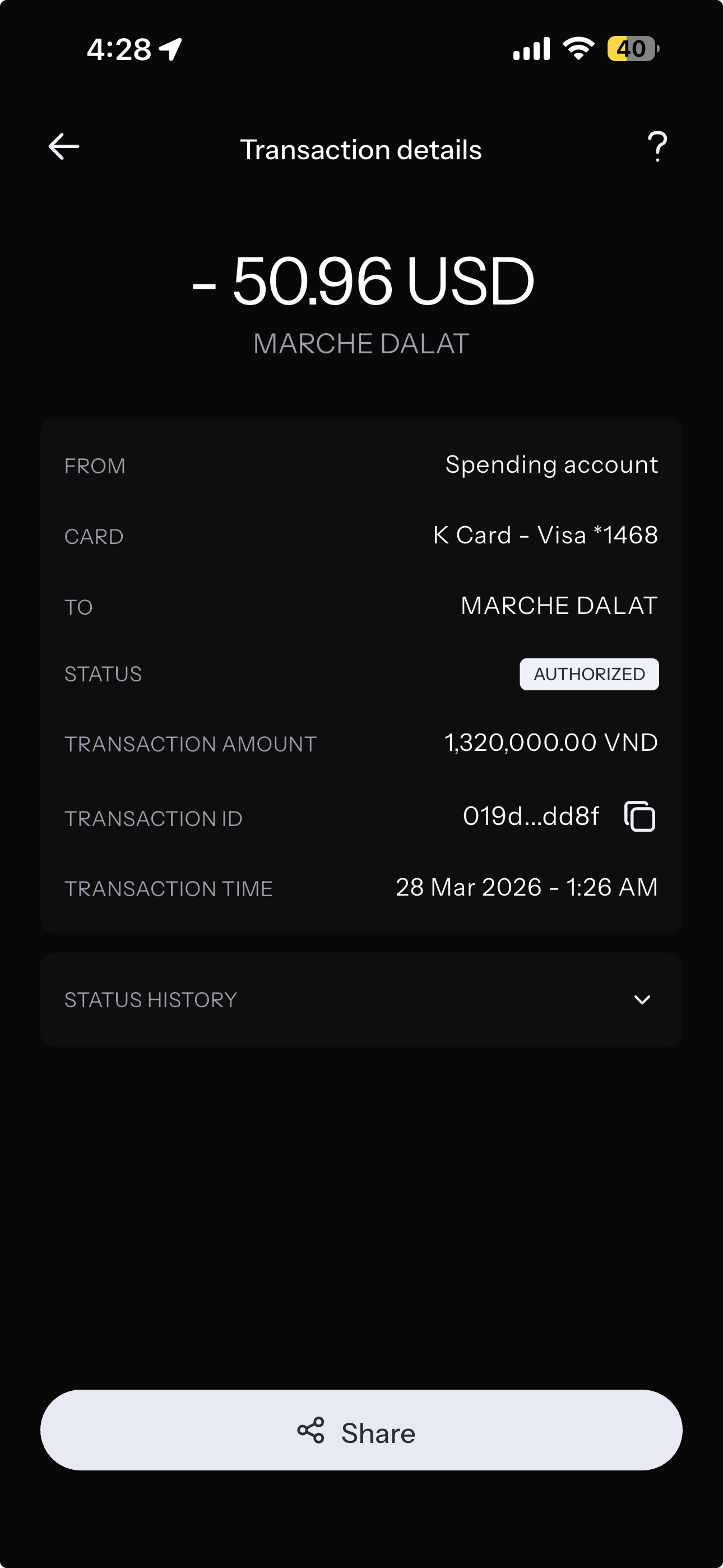
KAST fees seems to be slightly higher compared to Ready and EtherFi
On pure FX: Ready wins, EtherFi is close, KAST is the most expensive.
The rewards picture — and why KAST might still win?
Here's where it gets counterintuitive.
Ready gave me $0.07 in STRK on that $2.24 transaction — about 3% cashback. STRK is live and tradeable. Straightforward.
EtherFi gave me $0.06 WETH on the $2.25 transaction — about 2.7% cashback in ETH. Also liquid.
KAST gave me 113.75 MOVE tokens worth roughly $2.04, plus 10.19 KAST Points worth approximately $1.02 — on a $50.96 spend. That's about $3.06 back, or 6% effective cashback. Even after the 1.6% FX drag, I'm netting around +4.4% on that transaction.
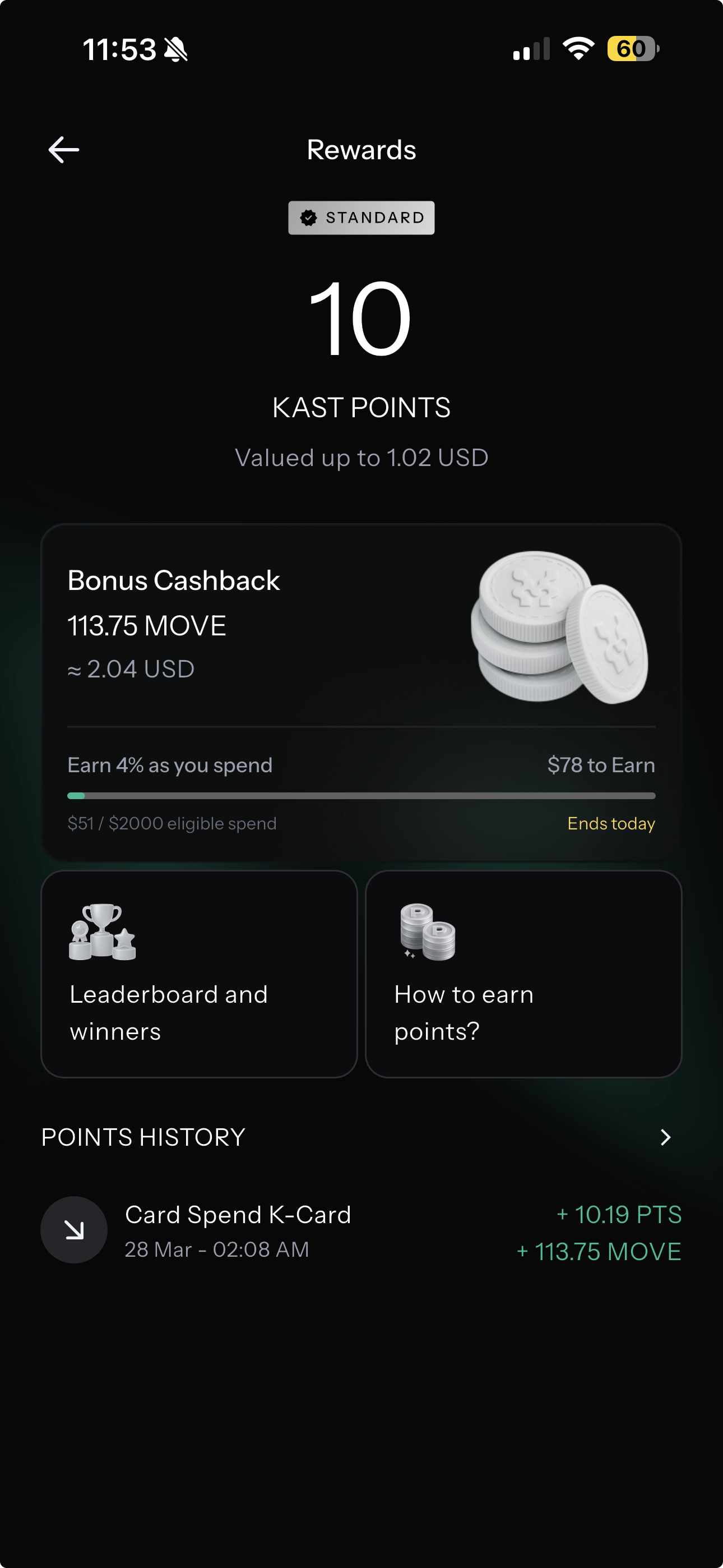
$MOVE tokens and KAST Points as rewards from Spending with KAST!
Two things worth noting on KAST's rewards. The $MOVE tokens are listed on major exchanges like Binance and OKX, which means you can sell them today. The KAST Points are a different story. They convert to $KAST tokens at TGE, which is targeted for Q4 2026. That token doesn't exist yet. I'm not counting it as a guaranteed value.
But even if you strip out the points entirely and only count the MOVE tokens, KAST still nets positive after the FX cost on a transaction this size.
How would I actually use these cards after this experiment?
I'm not picking one. I'm stacking two.
Ready or EtherFi goes in my wallet for daily spending — coffee, grab rides, convenience stores, anything small. Zero FX spread, liquid rewards, reliable UX. It's the card I don't have to think about. Selecting between Ready and EtherFi solely depends on which ecosystem you want to be in. If you’re in the Ethereum ecosystem, go with EtherFi; if you’re curious about Starknet and what they are building, Ready would be the one to go for!
KAST comes out for bigger purchases — restaurants, hotels, anything meaningful. The math works in its favour once the transaction is large enough for the 4% MOVE cashback to absorb the FX fee. On a $200 hotel bill, that's roughly $8 back in liquid tokens after costs. That's not trivial.
Who should get which card?
If you want one card and nothing else, get Ready. Near-zero FX spread, instant digital card, liquid rewards. The most straightforward option in this comparison.
If you're already in DeFi and hold ETH, EtherFi makes sense as a secondary card. Your cashback compounds within the ecosystem you're already in.
If you spend meaningfully when you travel — $50+ transactions on meals, hotels, experiences, KAST earns its place in your wallet. The 4% MOVE cashback is aggressive enough to overcome the FX cost once transaction sizes are large enough. Just go in clear-eyed that the KAST Points layer is speculative until TGE.
The optimal stack for most people reading this: Ready + KAST. One for daily use, one for big spends. Between them, you're covered.
All FX rates are from my actual transactions in Vietnam, March 2026. Mid-market rates from State Bank of Vietnam and Vietcombank published rates. MOVE and STRK values were approximate at the time of each transaction and will vary.
I have referral links for all three cards below — some come with sign-up bonuses. These are cards I used on this actual trip, not cards I was sent to review.
